Optimizing the onboarding process of TribeScale (B2B SaaS)

Challenge
TribeScale was a web and mobile-based team management platform that aimed to bring the agility and high performance of startup teams to companies of all sizes.
While acquisition and conversion weren’t an issue, new users struggled to understand where to start and how to activate their teams after signing up.
Solution
A redesigned onboarding experience, developed through a Design Sprint, that guided managers based on their goals.
This redesign helped users understand the value of the platform and set a custom setup to quickly onboard team members and start making the most of its features.
Results
A clearer and personalized onboarding flow that improved understanding of the product and supported team activation.
The project
Project team
Alexis Roqué – Product Owner
Alberto Alcaraz – CEO
Daniel González – CTO
Josean Muñoz – Marketing Manager
Gabriel Anglada – Developer
Hana Gausfain – UX Design & Customer Success
Silvia Calvet – DS Master
Understanding the activation challenge
TribeScale aimed to become the all-in-one platform to improve the team’s performance, agility and communication.
Given the range of its features, which included communication channels, team and company level dashboards, and goal tracking tools, helping users understand where and how to start was a key challenge since the very beginning.
Acquisition and conversion rates through the website were not an issue, as users understood and were interested in the product message and functionalities.
However, once registered, fewer users than expected managed to invite their teams and use the app on a regular basis.
For several months, we explored different strategies, including predefined team templates (called tribes), welcome channels, and free demo sessions to encourage team activation.
We finally decided to focus all efforts on the improvement of the onboarding through a Design Sprint with an external facilitator.
Defining the product vision and the user personas
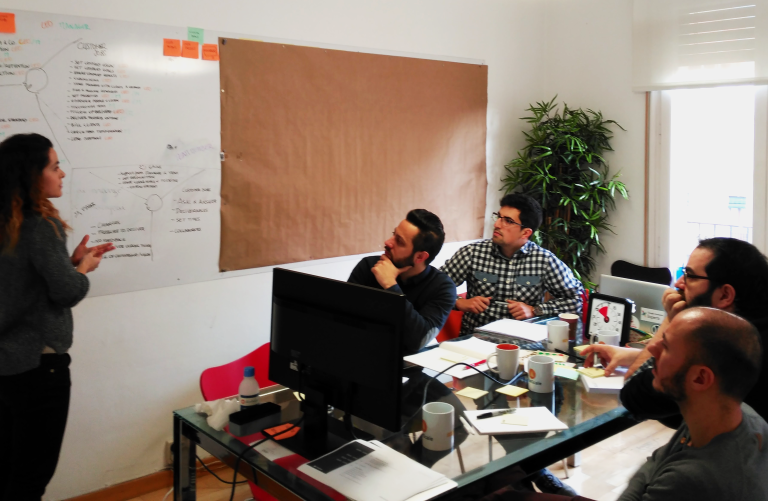
The first step of the Design Sprint focused on clarifying the vision, user personas, and value proposition.
I was in charge of running previous research and persona creation, and presenting it to the group for discussion.
On day one, we complemented my work by contacting potential users to understand their context and adapt our message to their needs.
We could group their needs into three categories:
- Communication: Easy follow-up with team members
- Alignment: Communicate priorities and goals
- Tracking: Monitor project progress
After analysing the research insights, we understood that our main target were managers controlling several teams or working remotely, looking to empower their people while keeping on track with business.
We also reached some conclusions regarding the type of experience we wanted our users to have: team managers should feel guided and motivated to start using our app to improve their teams.
Defining a new User Journey
As the UX during the sprint, I mapped the user journey of managers signing up to TribeScale.
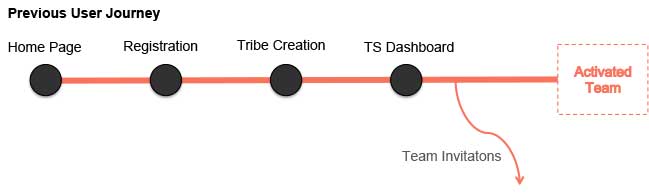
The journey started with the registration for a TribeScale (TS) account, followed by the creation of a tribe (team), which then finally led to the dashboard.
Once there, a series of tooltips helped the users identify key areas of the dashboard and invited them to take action by inviting their team members or writing a first message.
All users followed the same journey and were expected to identify the right configuration for their teams and discover advanced features on their own.
Unless they actively reached out for support, there was little guidance on how to set up a tribe according to their specific needs.
We understood we had an opportunity to personalize the experience and bring more value to users.
Defining a new user journey
Based on the new design principles, we designed an onboarding flow that was guiding, educational, and motivating.
We focused on our 3 main functionalities and their benefits:
- Structured communication
- Shared goals and priorities
- Automatic reporting
And decided to offer three different onboarding flows depending on their main need.
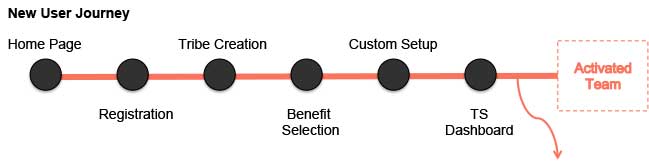
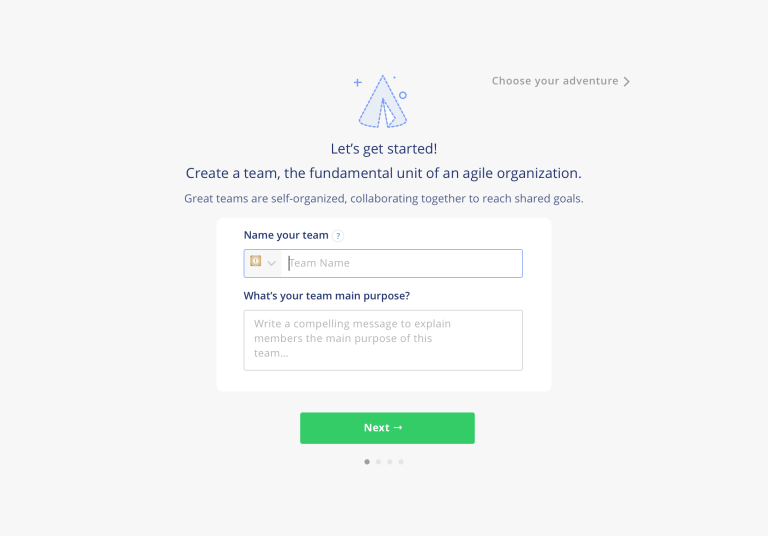
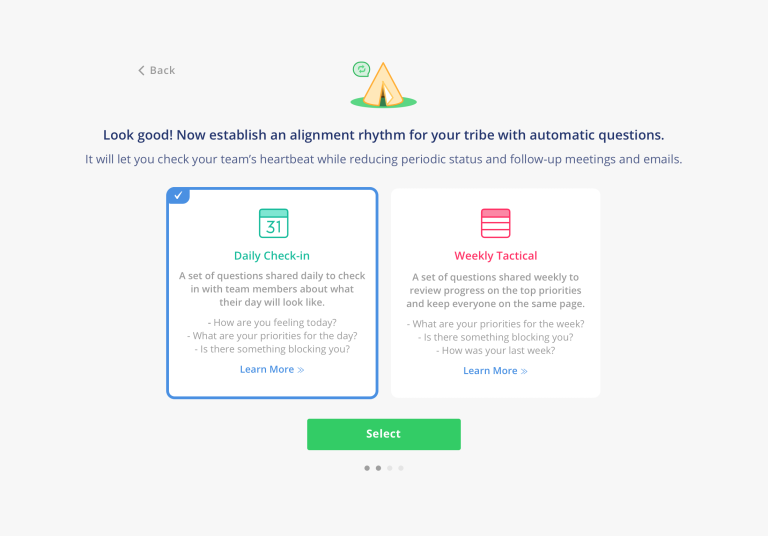
For this, we designed a wizard that guided users along the custom setup.
The goal was to quickly identify the users’ main motivation and provide insight into how the app could help meet their needs in a few minutes.
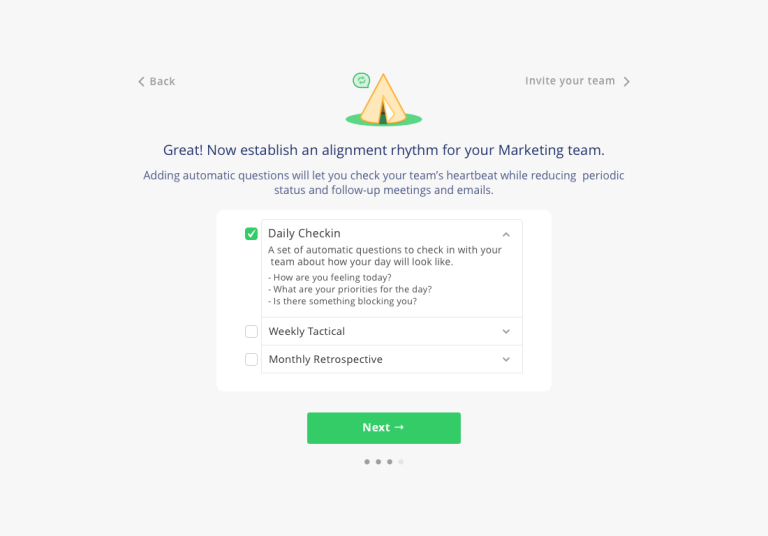
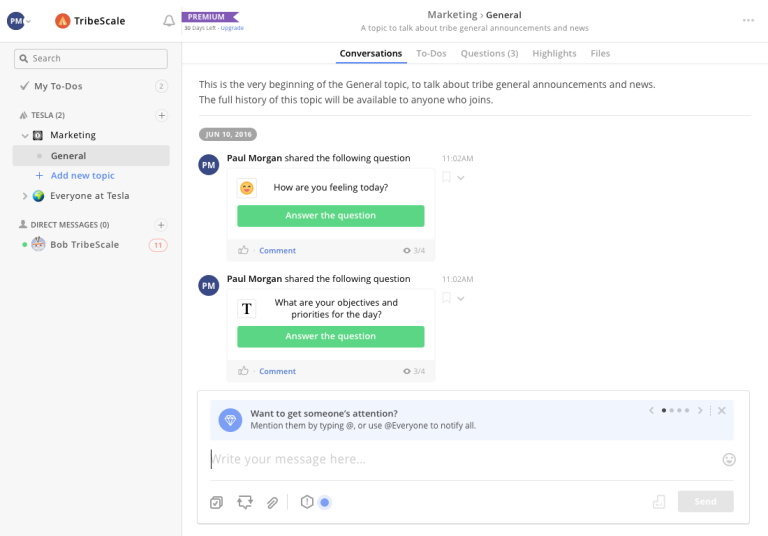
For instance, for users focused on automatic reporting, we set a series of daily and weekly questions that would be shared automatically on their tribe chat channel.
We also wanted users to be able to see the results of their setup right away to get the momentum going. We did that by designing a customized dashboard at the end of the flow.
My main responsibilities included adapting the content of the homepage and crafting the content of the different screens of the new onboarding flow.
User testing and iteration
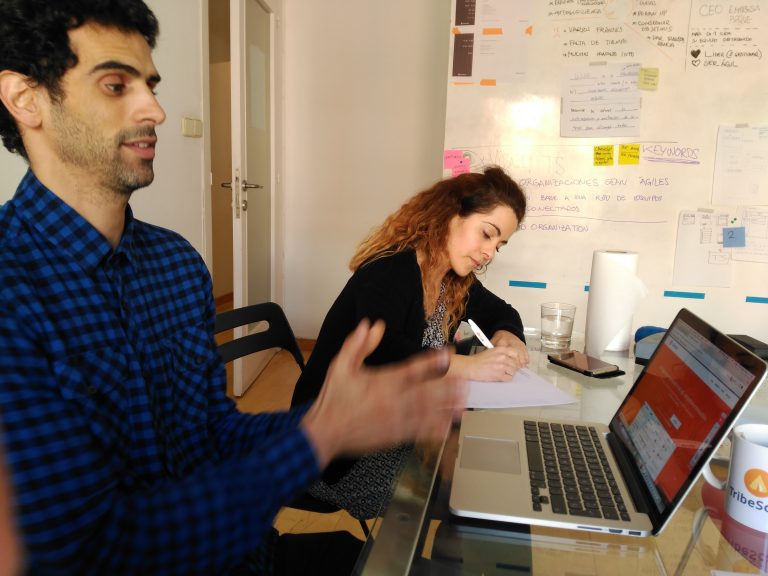
Once the new mockups were ready in Sketch, we built an interactive prototype using InVision.
We invited a group of potential users to test the new onboarding flow and gather feedback.
We confirmed our hypothesis that allowing the user to choose a particular aspect they wanted to improve in their team and clearly explaining how the app could help them with that issue specifically was motivating to start using the platform.
We did some redesigns after the test, such as clearly showing the specific questions that would be sent in the “Effective alignment” path.
We also removed the screen prompting users to invite their teams in the flow, as participants preferred to first explore the dashboard.
Working on TribeScale’s onboarding highlighted the importance of aligning product complexity with clear guidance from the start. The redesigned flow focused on helping users understand the value of the platform early on, while supporting different team needs through a more structured experience.
Client feedback
I’ve had the pleasure of working with Hana for a short but intense period of time. During this period I have been able to enjoy her professionalism and commitment to the company.
Hana is a great professional, methodical and passionate about her work.
A very versatile profile that thrives in everything related to UX design and product. Her orientation to detail and ability to put herself in the user’s shoes make her a person of great value for any product team.
Without any doubt, I would work with her again.
Próximos pasos
Basándonos en el éxito del rediseño, ahora estamos explorando la posibilidad de agregar información impulsada por inteligencia artificial para brindar recomendaciones financieras personalizadas y mejorar aún más la experiencia del usuario.
Related projects